Your Testosterone Drops Up to 43% Every Day.
Track It.
Your testosterone peaks at 6 AM and crashes by evening. Flux maps your 24-hour hormonal rhythm so you know when to train, focus, rest, and perform at your best.
Built for Men Who Optimize
Six core tools to understand and leverage your body's natural rhythm — backed by endocrinology, not bro science.
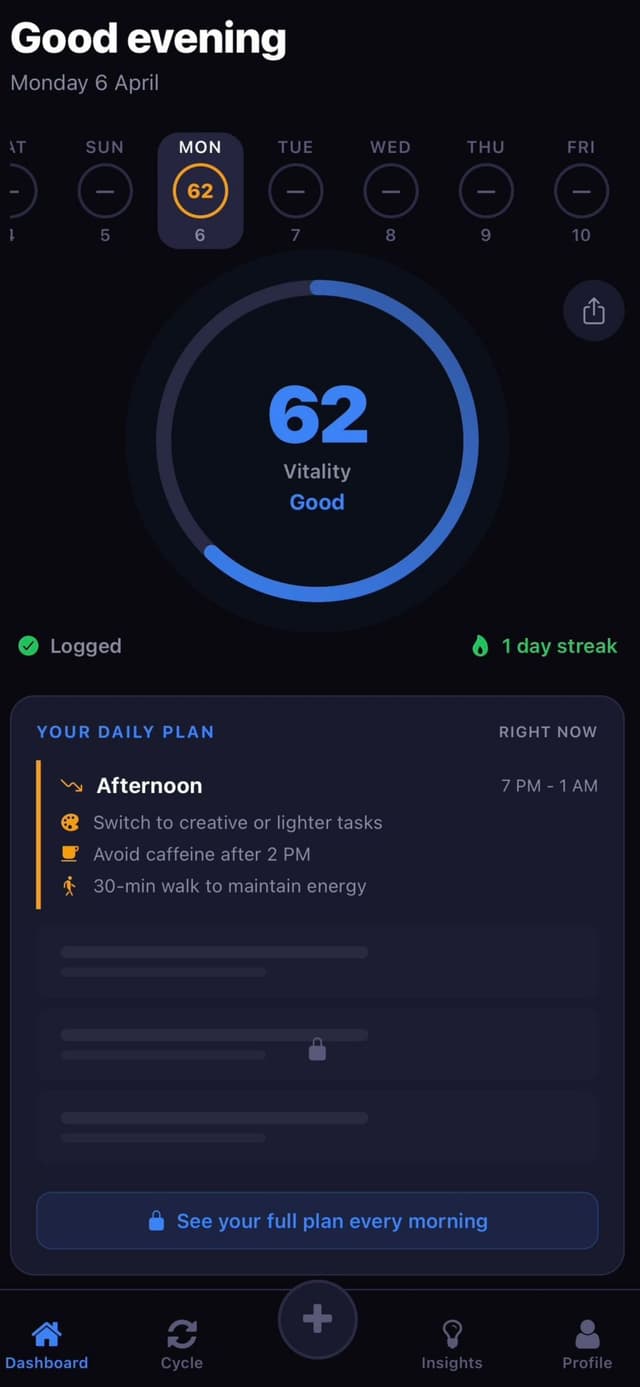
Vitality Score
A single number (0-100) that captures your daily hormonal state based on 6 key metrics. See where you rank among men your age.
60-Second Check-in
Log Energy, Mood, Libido, Sleep Quality, Stress, and Physical Activity in under a minute. The science shows these are the key markers.
AI Daily Plan
Personalized recommendations based on your phase: when to train, focus, avoid caffeine, and wind down. Powered by predictive AI.
4 Hormonal Phases
Rise, Peak, Decline, Recovery — know exactly where you are in your 24-hour cycle. Based on peer-reviewed circadian research.
Circadian Rhythm Graph
Visualize your 24-hour testosterone curve — from the 5:30 AM surge to the evening nadir. Plan your day around your biology.
Wearable Integration
Connect Apple Watch, Oura, or WHOOP to auto-track sleep, HRV, and activity. Less friction, better data, smarter insights.
See Flux in Action
A complete view of your hormonal health, designed for daily use.
Dashboard
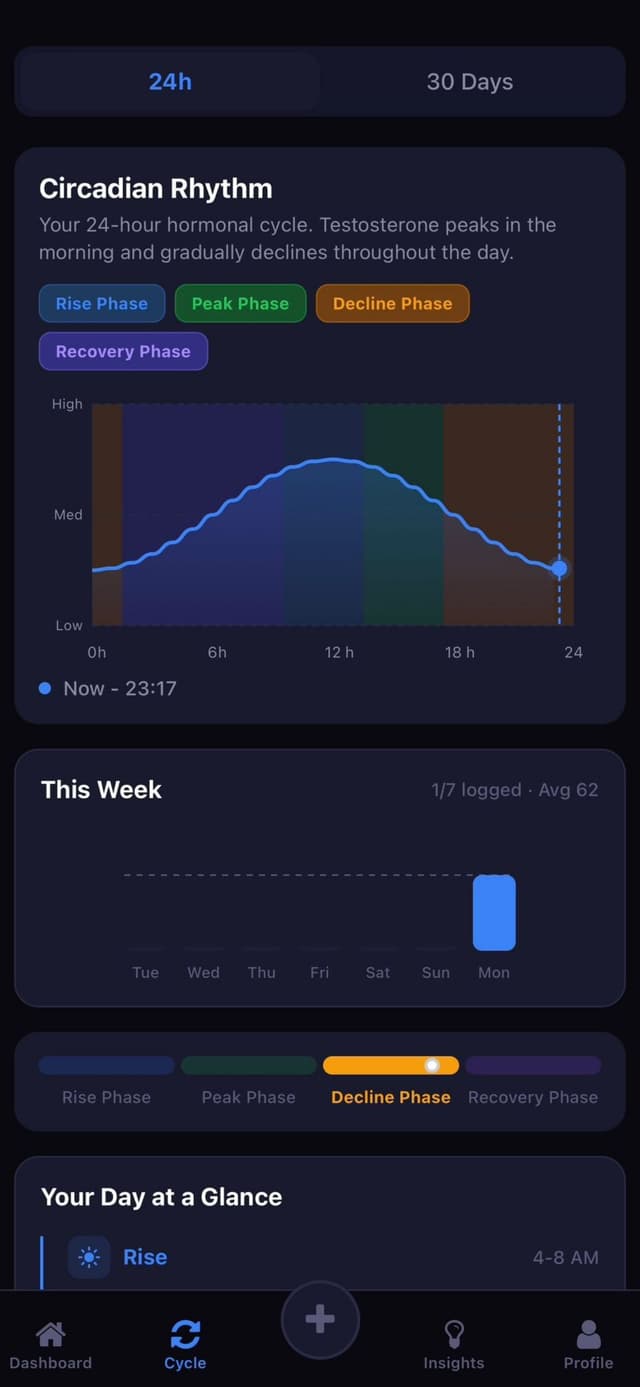
Circadian Rhythm
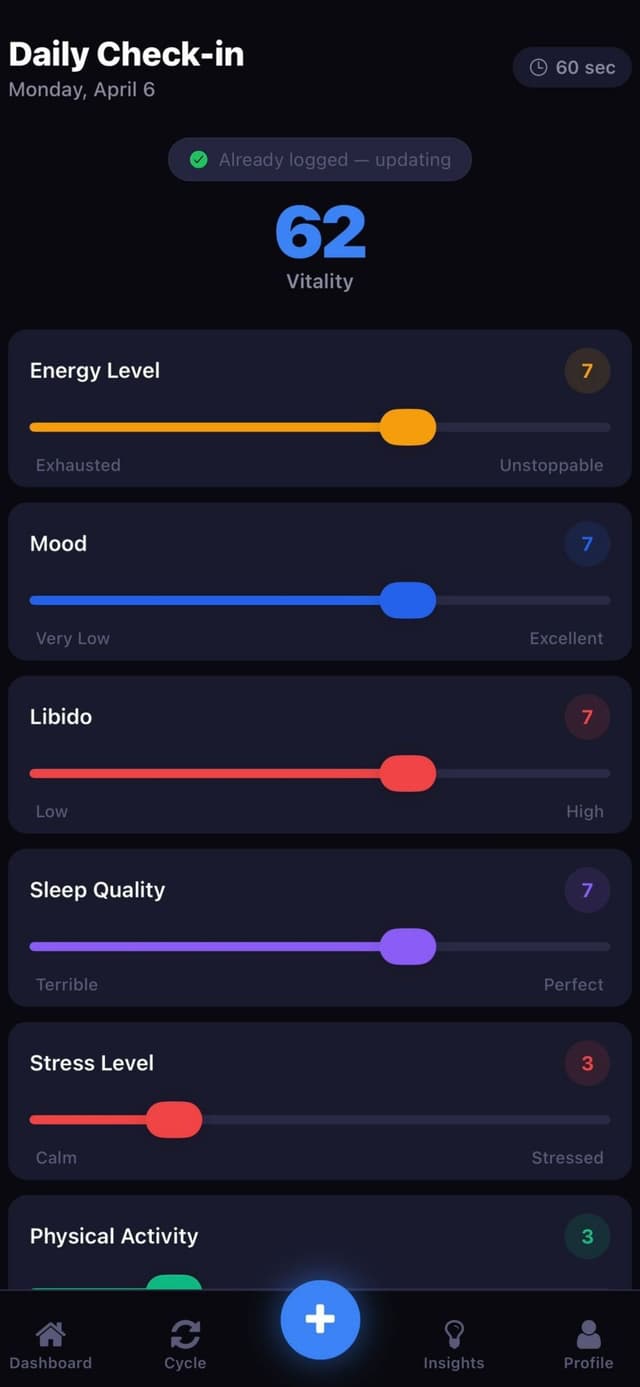
Daily Check-in
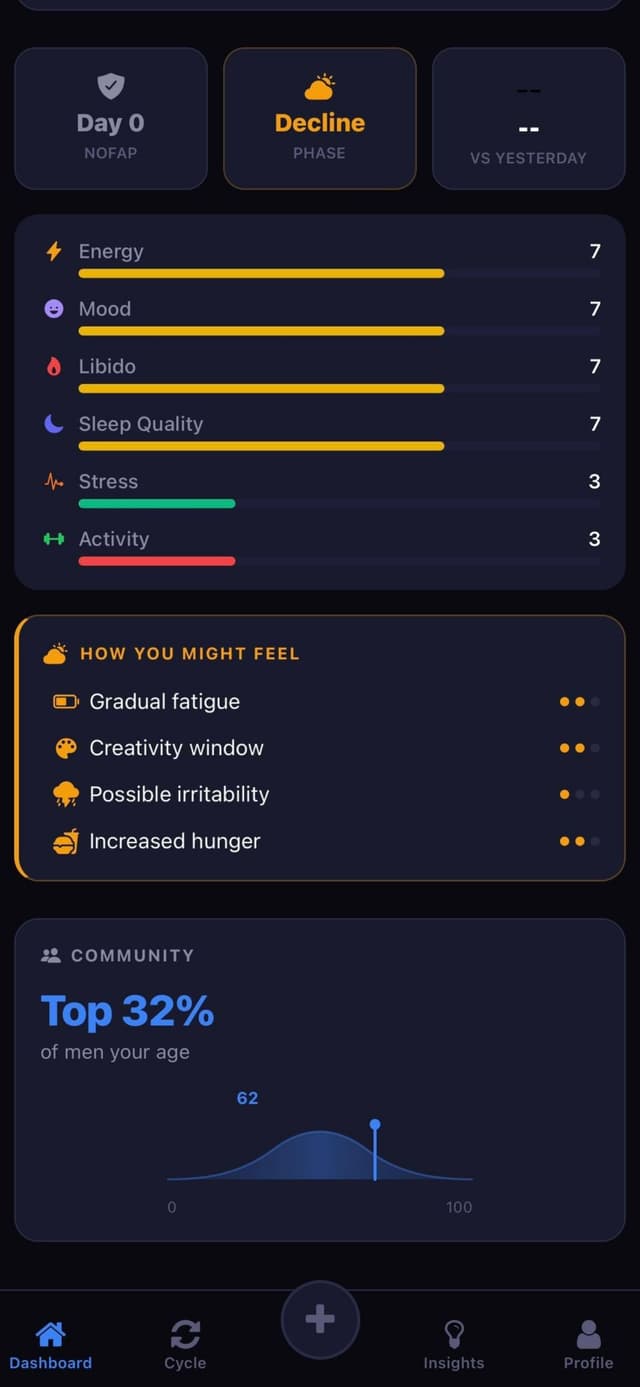
Insights
How It Works
Three steps to take control of your daily performance.
Check in Daily
Rate your Energy, Mood, Libido, Sleep, Stress, and Activity. Takes 60 seconds.
Understand Your Rhythm
See where you are in your circadian cycle: Rise, Peak, Decline, or Recovery phase.
Optimize Your Day
Get a personalized plan: when to train, focus, rest, and avoid caffeine.
Backed by Science, Not Bro Science
Flux is built on peer-reviewed endocrinology research — not influencer claims or supplement marketing.
Testosterone drops from its morning peak to evening nadir. The decline reaches 25% in young men and up to 43% across all ages.
Brambilla et al., 2008 & Diver et al., 2003 — J Clin Endocrinol Metab
The testosterone peak window. Your body produces the most testosterone during late sleep and early morning hours, driven by REM sleep.
Luboshitzky et al., 2001 — Sleep Research
Testosterone reduction caused by just one week of sleeping only 5 hours per night. Sleep is the #1 lever for hormonal health.
Leproult & Van Cauter, 2011 — JAMA
The 4 Phases of Your Daily Hormonal Cycle
Testosterone surges during late sleep. You wake with peak hormonal drive.
Highest energy, focus, and physical strength. Ideal for demanding tasks and workouts.
Gradual hormonal descent. Switch to creative work, lighter exercise, social activities.
Lowest testosterone. Wind down, avoid caffeine, prioritize sleep quality.
Why track your hormonal rhythm?
Unlike the monthly female cycle, the male hormonal cycle operates on a 24-hour loop. Testosterone peaks between 5:30-8:00 AM and gradually declines throughout the day, reaching its lowest point around 7 PM. Research shows this rhythm directly affects your energy, mood, focus, libido, and physical performance — following a well-documented inverted-U curve.
Emerging research also suggests the existence of ~20-30 day infradian cycles in men. A landmark study (Doering et al., 1975) found detectable testosterone cycles in 60% of subjects, with periods clustering around 20-22 days. More recent salivary studies confirmed both ~20-day and ~30-day rhythms with high statistical significance.
Flux helps you understand these rhythms so you can schedule workouts, deep work, rest, and social activities at the optimal time — working with your biology instead of against it.
Your Hormones Are Already Cycling.
Start Paying Attention.
Join the first generation of men tracking their hormonal rhythm. Free to use. 60 seconds a day. Built on real science.